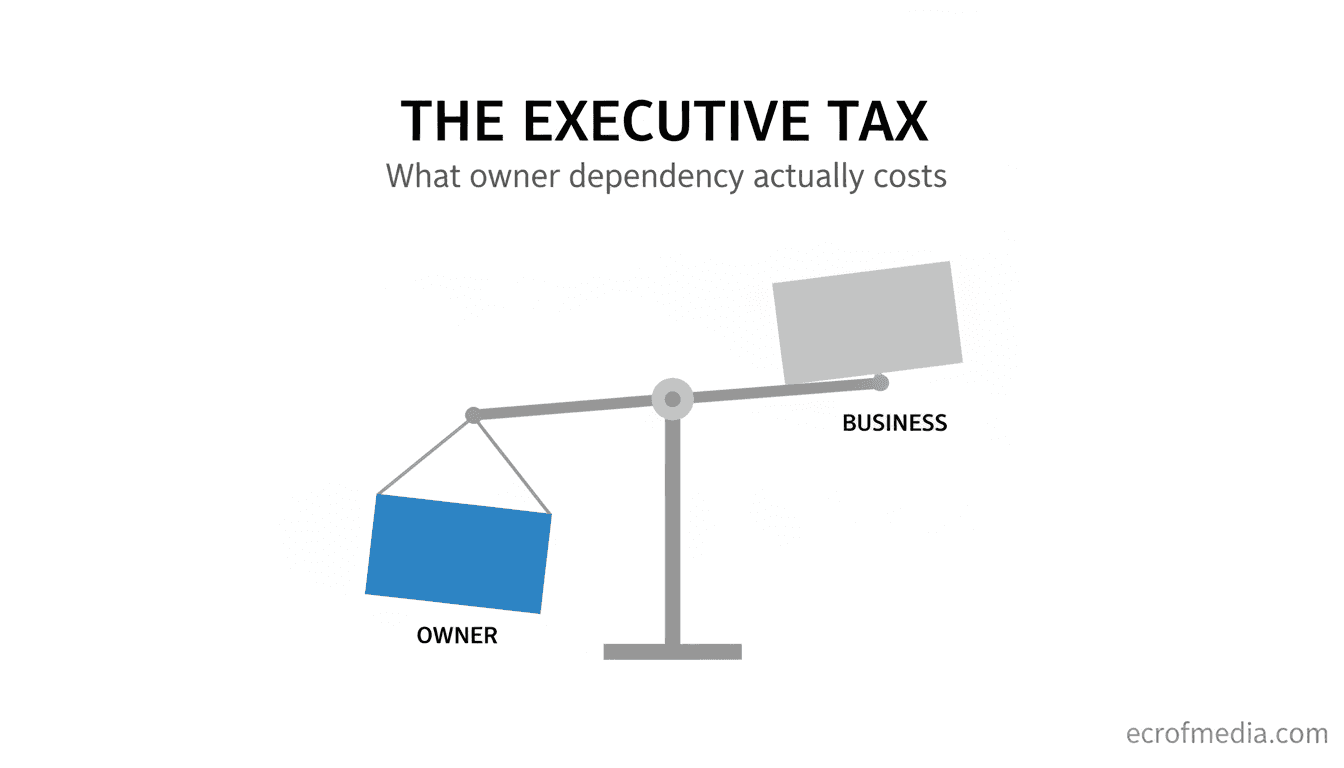
What Is Executive Tax? The Hidden Cost of a Business That Depends on You
It never shows up on your profit and loss statement. You pay it in time, attention, decisions, and the opportunities you never got to.
Executive Tax is the hidden cost created when a business depends too heavily on its owner's time, attention, decisions, and intervention.
It does not appear as a line item on your profit and loss statement. You feel it in delayed decisions, missed follow up, repeated questions, unnecessary rework, customer delays, and hours of owner time spent doing work the business should be able to handle without you.
The business can be profitable and growing, and still be paying a significant Executive Tax.
That is the whole thesis, and it is short enough to keep. More owner dependency, more Executive Tax.
You may be paying Executive Tax if
Your team waits for your approval.
Customers still call you when something goes wrong.
Sales opportunities sit because you are busy.
People ask questions you have answered before.
You check work because you are not confident it happens correctly without you.
You have software, written processes, and people, and you are still the thing connecting all of it.
None of these looks catastrophic on its own.
That is exactly why it is so hard to see. Executive Tax never arrives as one large problem. It arrives as a hundred small ones, each of them reasonable, each of them easy to explain away on the day it happens.
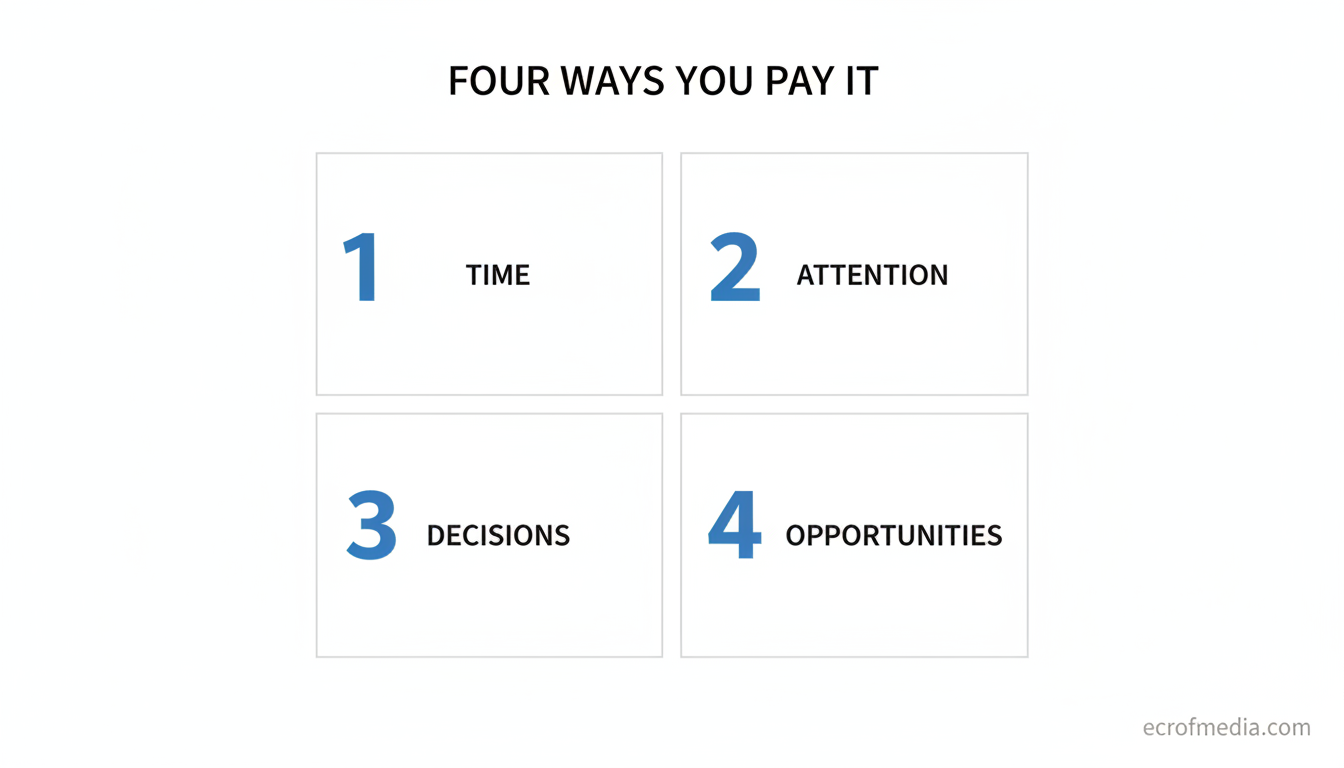
Four ways you are already paying it
Executive Tax is not paid in money first. It is paid in four things you cannot invoice for, which is why it stays invisible for so long.
1. Your time
You are doing work below the highest value contribution only you can make.
You spend Thursday afternoon rebuilding a quote because whoever started it did not know how the pricing flexes for a repeat customer. Two hours. The quote is correct now. The strategic work Thursday was for did not happen, and it will not happen next Thursday either, because next Thursday has its own quote.
2. Your attention
Constant questions, approvals, and interruptions fragment your ability to lead.
Nine interruptions across a day, none of them longer than four minutes. On paper you lost half an hour. But leading takes a kind of thinking that needs a runway, and a day chopped into nine pieces never gives you one. The cost is not the thirty minutes. It is that you never got to the altitude where the real decisions get made.
3. Your decisions
Work slows down because too many decisions eventually come back to you.
A customer asks for something slightly outside the normal scope. Nobody is sure whether to say yes, so it waits until you are free. You take eleven seconds to decide. The customer waited two days. The business is not slow because the work is slow. It is slow because it keeps stopping to ask.
4. Your opportunities
The most expensive Executive Tax is what never happens at all.
The partnership you did not pursue. The salesperson you did not train. The client you did not follow up with. The market you did not enter. None of it shows up anywhere, because a thing that never happened leaves no record. This is the largest line on the bill and the only one you will never be shown.
The Executive Tax nobody talks about
If you would rather see the complete breakdown, I walk through how Executive Tax shows up inside a business, why owners miss it, and what it actually costs.
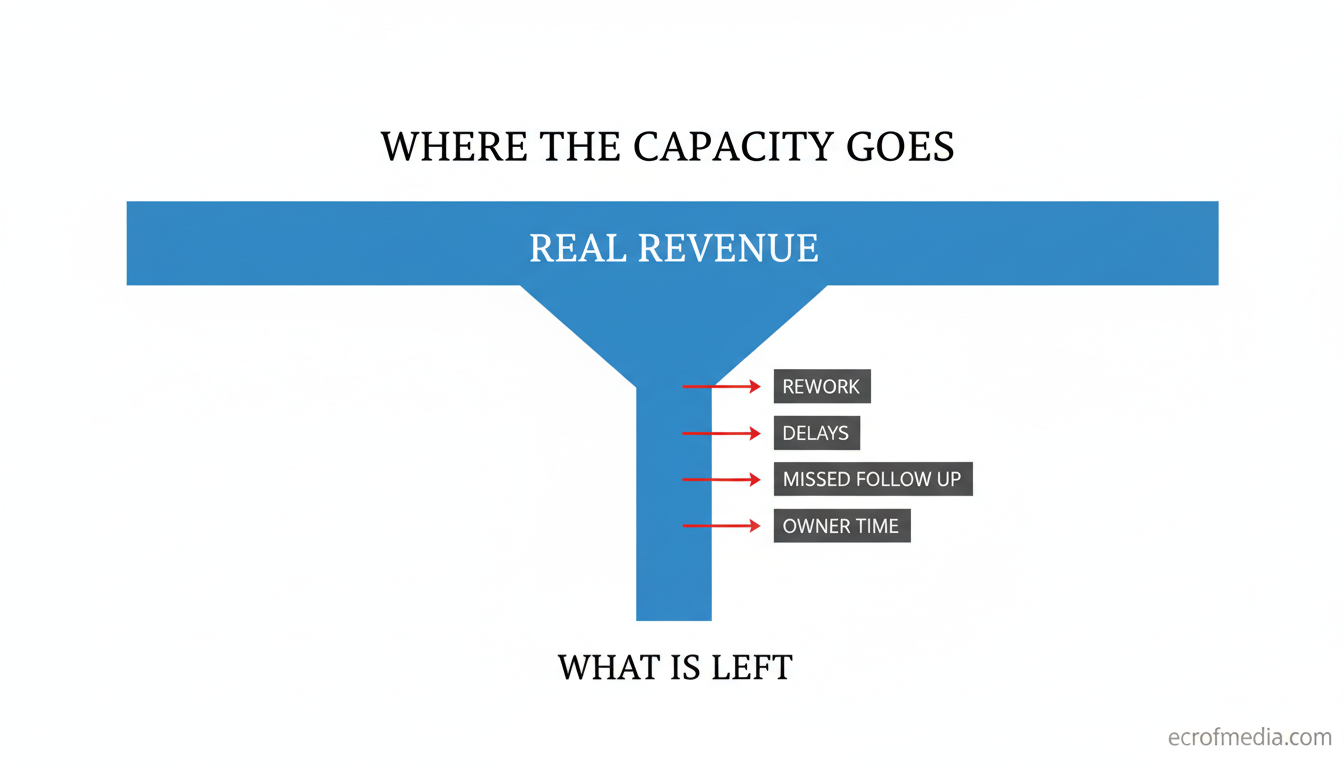
Where does the capacity actually go?
Start with the part every owner already knows.
Gross Revenue
minus Cost of Goods Sold
equals Real Revenue
Here is the part that never gets drawn. Before you get to think about profit, pay, hiring, or reinvestment, the business has already given some of that capacity away through costs nobody wrote down. Rework. Delays. Missed follow up. Owner hours.
Be precise about this
Executive Tax is an economic cost, not an accounting category. Your bookkeeper will never find it, and any framework promising to put it on your profit and loss statement is selling you something. It is real the way opportunity cost is real. It shows up in what the business was able to do, not in what it recorded.
Picture a facility maintenance company
The owner runs a facility maintenance company. Real customers, real crews, real revenue.
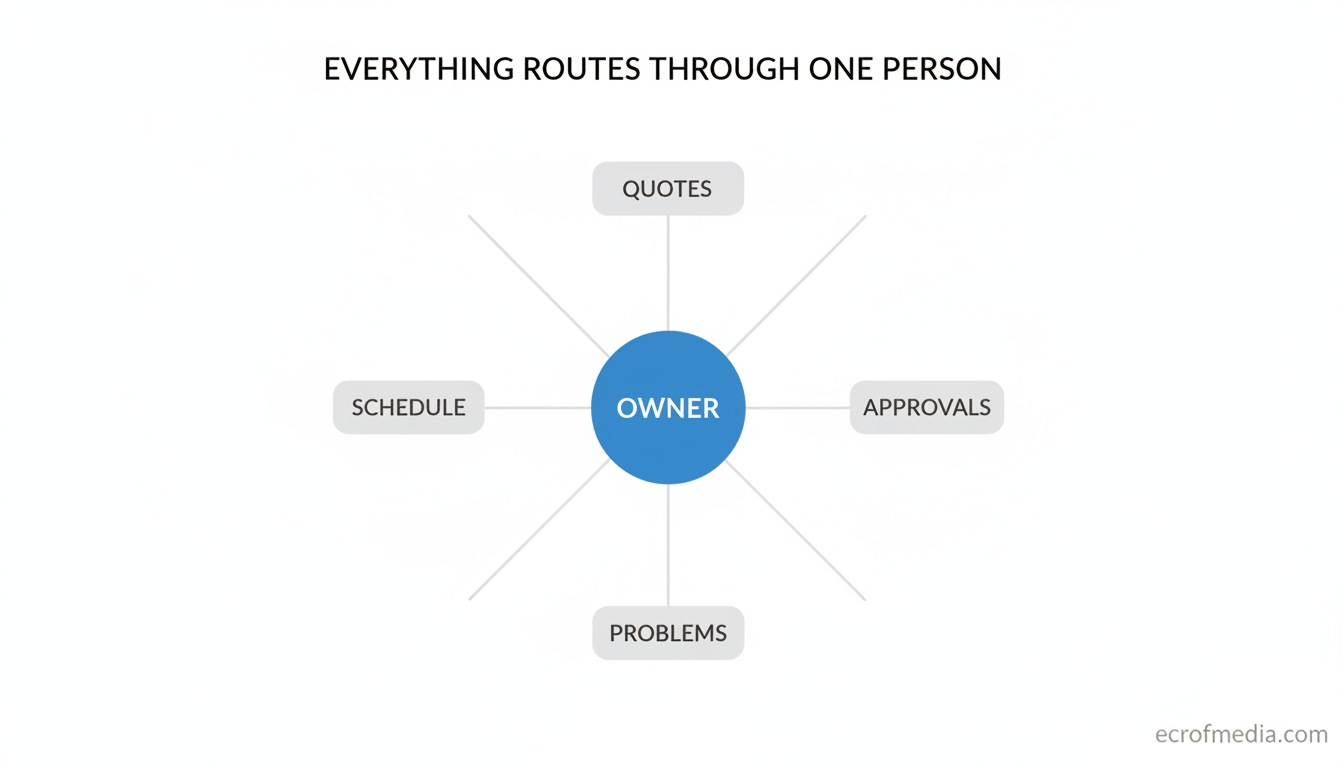
And in a normal week he is still the one taking the customer calls when something goes wrong. Still the one his people come to for answers. Still the one who has to touch a quote before it goes out. Still the one problems escalate to. Still the one holding the information scheduling depends on.
He is making money. The company is operating. On paper he is doing exactly what an owner is supposed to do.
That owner was me.
Here is what I had wrong at the time. I thought being needed that much was evidence the business was working. Every call I took was proof the customers trusted me. Every question my crew brought me was proof they cared about getting it right. Every quote I touched was proof of my standards.
It was not proof of any of that. It was a bill.
I was paying it in evenings, in opportunities I kept postponing, and in a company that could not move faster than one person could answer questions. I did not have a time management problem or a discipline problem. I had built a business that required me to function as its operating system, and then I was surprised it needed me all the time.
Executive Tax is not a term I invented for marketing. It is the name I eventually gave to the thing I had been paying for years without knowing what to call it.
Can I just hire more people?
Sometimes. But here is the trap.
If the knowledge, decisions, standards, and context still live with the owner, then hiring another person creates another person who needs access to the owner. You did not reduce the dependency. You added a line to it.
This is why so many owners feel busier six months after a hire than they did before, and then conclude they hired wrong. The hire was usually fine.
More software does not equal less dependency.
More written process does not equal less dependency.
More people does not equal less dependency.
None of those are bad things to have. They are just not answers to this question. The real question is narrower, and it is the only one worth asking.
Can the business get what it needs to know, decide what it needs to decide, and move the work forward without coming back to you?
What does a low Executive Tax business look like?
It is not a business where the owner disappeared. It is a business that knows things.
- Who owns what
- What happens next
- Where information lives
- When something needs to be escalated
- What decisions people can make on their own
- How work gets handed from one area to another
- What the standards actually are
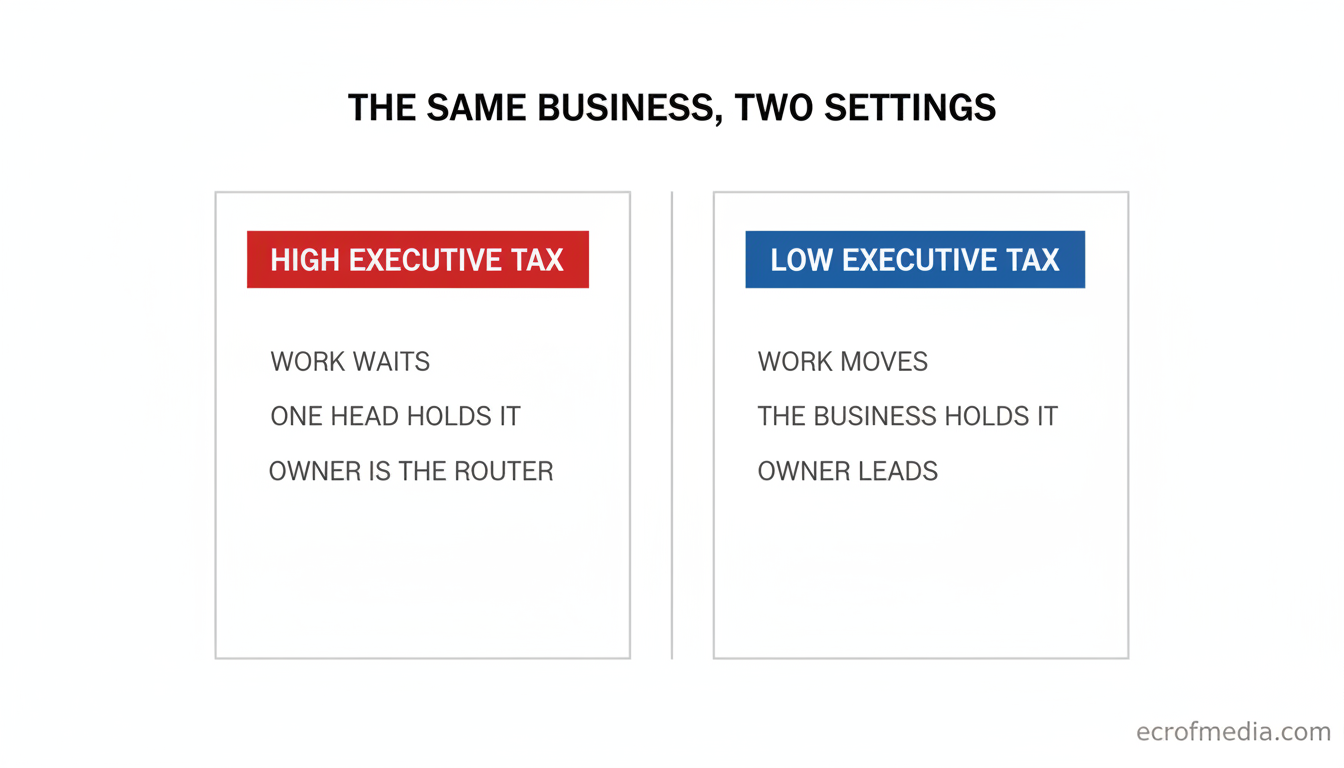
The owner still leads. The owner just is not required to function as the operating system.
Ask yourself these five questions
If I disappeared for five business days, what would stop?
What decisions can nobody make without me?
What questions did I answer more than once this week?
What opportunities am I postponing because I do not have the capacity?
Where does information live mostly in my head?
Write the answers down. Not in your head, on paper.
Those five answers give you an early picture of where your Executive Tax is hiding. Most owners find the fourth question is the one that stings.
The move
Take the single answer that bothered you most and find the one piece of information behind it that only exists in your head. Write that one thing down somewhere the business can reach it. That is the smallest possible payment against the largest bill you have.
Measure it
How much Executive Tax are you paying?
Executive Tax looks different in every business. The Executive Tax Assessment asks twelve questions across Marketing, Sales, Operations, and Customer Service to find where your company leans hardest on your time, attention, and decisions, and where that dependency is capping what you can take on. It takes about four minutes and there is no call to book.
Calculate Your Executive TaxExecutive Tax, answered
What is Executive Tax?
Executive Tax is the hidden cost created when a business depends too heavily on its owner's time, attention, decisions, and intervention. It is paid in delayed decisions, repeated questions, rework, missed follow up, and owner hours spent on work the business should be able to move without them.
Is Executive Tax an actual accounting expense?
No. It is an economic cost, not an accounting category. It never appears as a line item on a profit and loss statement, which is exactly why it goes unmanaged for years. You measure it by watching where work waits, not by reading a ledger.
How do you calculate Executive Tax?
Start by finding every place work stops and waits for the owner. Count the decisions that cannot be made without you, the questions you answered more than once this week, and the work that sat because you were busy. Each one has a delay attached, and the delays are the cost. The Executive Tax Assessment does this across Marketing, Sales, Operations, and Customer Service in about four minutes.
What causes Executive Tax?
Knowledge that lives in one head instead of somewhere the business can reach. When the standards, the reasoning, the customer history, and the decision criteria exist only in the owner's memory, every piece of work that needs them has to route back through the owner to continue.
Can a profitable business still have high Executive Tax?
Yes, and most do. Profit measures what the business earned. Executive Tax measures what it gave up to earn it. A business can be growing, profitable, and busy while still paying heavily in owner capacity, which is why founders often feel worse as revenue improves.
Does hiring employees reduce Executive Tax?
Not by itself. If the knowledge, standards, and decision criteria still live with the owner, a new hire becomes one more person who needs access to the owner. Hiring reduces Executive Tax only when the person arrives into a structure that can answer their questions without you.
What is the difference between Executive Tax and owner dependency?
Owner dependency is the condition. Executive Tax is the price. Dependency describes how much the business needs the owner present. The tax is the capacity, speed, and opportunity that condition consumes every week.
Can better software reduce Executive Tax?
Software helps only where the answer already exists somewhere the tool can reach. A system cannot route a decision nobody has written down, and it cannot apply a standard it was never given. Point good software at owner dependency and you get faster requests arriving at the same bottleneck.
Where this comes from
- Harvard Business Review: Collaborative Overload, on the rising cost of coordination work
- Asana: Anatomy of Work, on time lost to work about work
- Gallup: employee engagement research, including whether people know what is expected of them at work
- U.S. Bureau of Labor Statistics: business employment dynamics and survival rates
See this in your own business.
We run a live workshop where we walk through exactly where your business intelligence is accessible and where it is still trapped. You will leave with a clear picture of what needs to be packaged first.
Join the Live Workshop