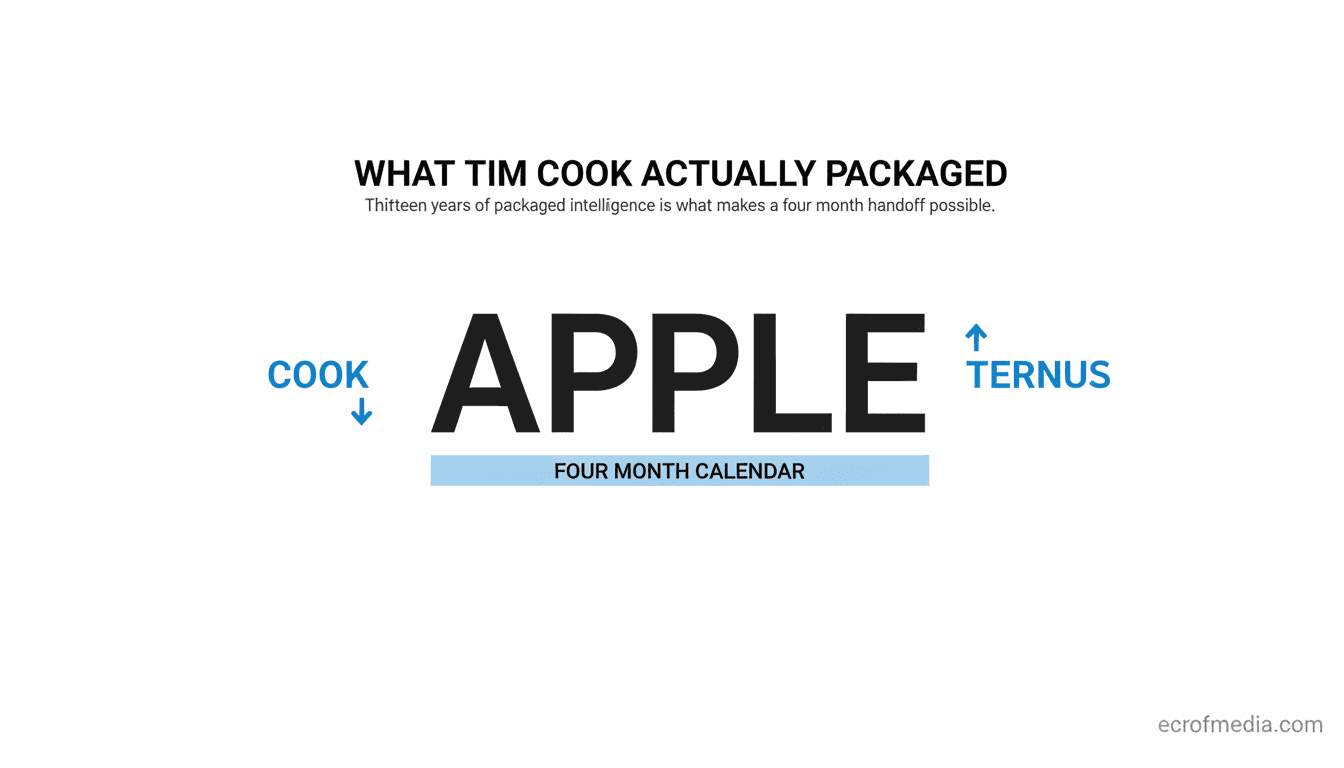
What Tim Cook Actually Packaged
Thirteen years of packaged intelligence is what makes a four month handoff possible. Most founders do not get that runway.
Most founders I sit with would not survive a four month transition calendar. The business would lose value the day after the announcement. The buyer would re-trade. The bank would tighten. The team would freeze. Apple did it Wednesday and the market did not flinch.
That is the story almost nobody is naming.
When Apple announced that Tim Cook would step down as chief executive in September, with John Ternus taking over, the press talked about the calendar. The four months of runway. The orderly handoff. The continuity message to shareholders. The fact that nobody was surprised.
The fact that nobody was surprised is the entire point.
Surprise is what happens when a business runs an unscheduled intelligence audit. A planned succession at Apple's scale is the only public version of an intelligence audit that gets to happen with runway instead of panic. The thing the press is calling boring is the rarest move in business.
You will probably never get this calendar. Almost no founder led business does.
The Pattern Nobody Names
Here is what Cook actually did at Apple over the last thirteen years that the analyst notes will not say out loud.
When Steve Jobs handed Apple to Cook in 2011, the company was an extension of one person's design judgment, product taste, vendor relationships, and decision style. Jobs had a way of running product reviews. A way of pricing. A way of pushing back on engineers. A way of negotiating with carriers. A way of deciding what shipped and what got cut. Most of that was carried in his head. The company had become very good at executing what Jobs decided, and almost no one inside the company could replicate the decisions themselves.
Cook did something almost nobody noticed at the time.
He spent thirteen years rebuilding the decisions into packaged structure. The supply chain ran on rules and forecasts that no longer needed Jobs in the room. The product review cadence became a system. The carrier negotiations became playbooks. The way Apple decided what to ship had been encoded into operating disciplines that survived Jobs without anyone being able to point to the moment the encoding happened.
Apple is not announcing a CEO change. Apple is announcing the completion of a thirteen year intelligence packaging project.
The handoff to Ternus is not a transfer of the founder's mind. It is a transfer of an operating system Cook spent a decade and a half packaging. That is why the calendar can be four months. That is why the market does not flinch.
What the Four Month Calendar Costs to Earn
Look at what Apple had to be true for that calendar to publish.
The product roadmap is set.
The vendor cadence is documented.
The pricing logic is in the model.
The supply chain is on rails.
The board reviews work the same way whether Cook is the one running them or not.
That state of operations does not happen at the moment of announcement. It happens years earlier. The announcement is the receipt.
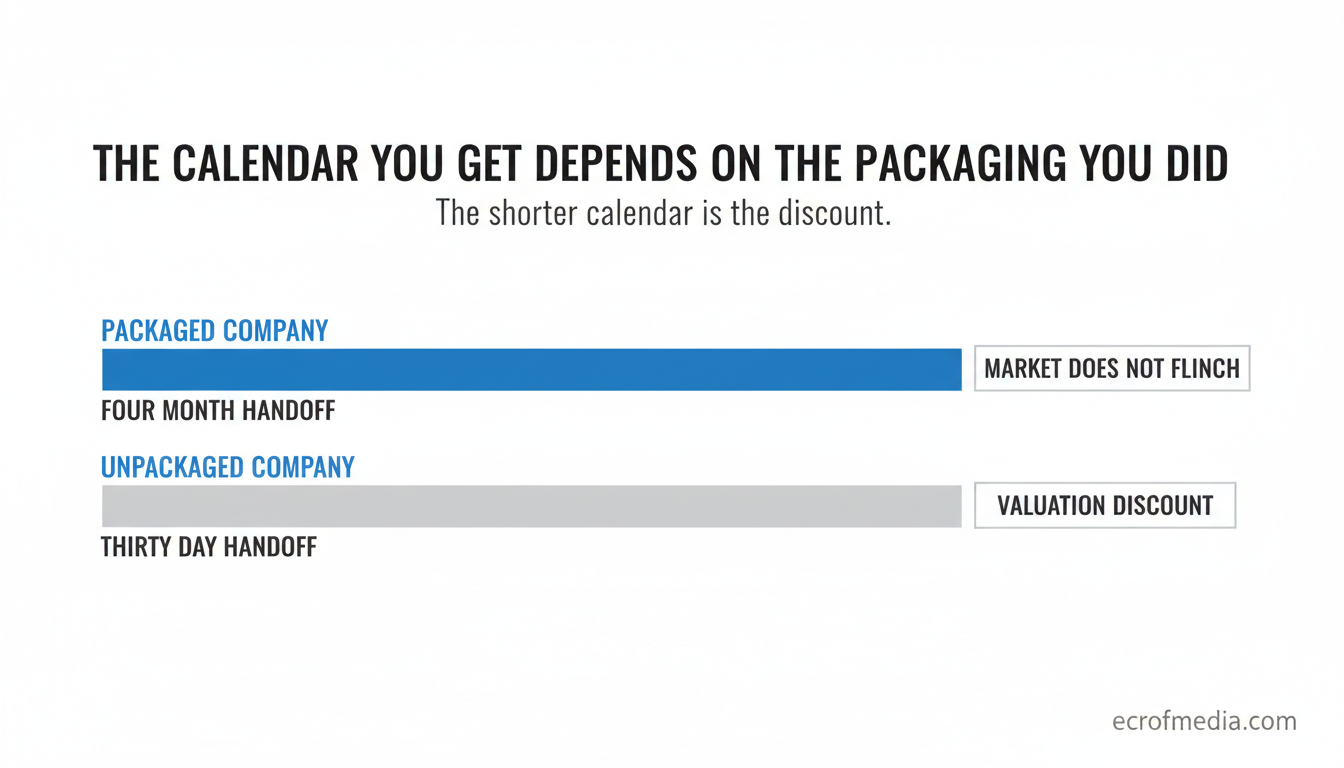
A company that has packaged its intelligence can publish a four month handoff calendar. A company that has not cannot. A company that has not gets a thirty day calendar, an interim leader, a press release that emphasizes continuity nobody actually believes, and a long quiet quarter where customers feel something is off and nobody can explain why.
Harvard Business Review's research on founder transitions found that founder CEO transitions carry a risk of failure or performance downturn two to three times greater than transitions involving nonfounder CEOs. Wipfli's 2025 State of the Banking Industry report put a number on the gap that does not get talked about: nearly fifty percent of firms had no formal succession plan at all, and the ones that did were investing in leadership development at a rate that climbed from seventy one to seventy seven percent in two years.
The market is pricing this in. You are either the company with the four month calendar or the company without it.
Why You Are Not on the Four Month Calendar Yet
I will tell you what I see when I run a Brain Map.
The owner runs the decisions. The senior operator who has been there twelve years carries the vendor relationships. The long tenured rep knows the pricing exceptions the spreadsheet does not capture. The founder negotiates the renewals because nobody else has the context. The way the business decides what to take on and what to walk away from is not written down anywhere because it has never had to be.
Then the event arrives.
A sale on a thirty day clock.
An illness.
A partnership dissolution.
A founder departure that catches the operating team off guard.
A buyer who wants to close in forty five days and needs to see clean operations.
The thirty day clock starts running. The audit Apple ran in thirteen years has to happen in thirty days. The intelligence that should have been packaged for that long is still in people. The people have to translate themselves under pressure, while continuing to run the business, while negotiating the terms of their own exit.
This is not a leadership problem. This is a packaging problem.
It is not that the founder is irreplaceable. It is that the intelligence the founder carried was never converted into something the next operator can pick up. The diligence team finds out. The buyer finds out. The price moves. The deal slows. Sometimes it falls through.
The Inventory That Buys Your Calendar Back
The lesson is not that you need thirteen years. Most of you reading this have months or quarters, not a decade. The lesson is what thirteen years bought Apple and what your gap has to buy you.
Thirteen years bought packaging. Not delegation. Not documentation in a folder. Packaging.
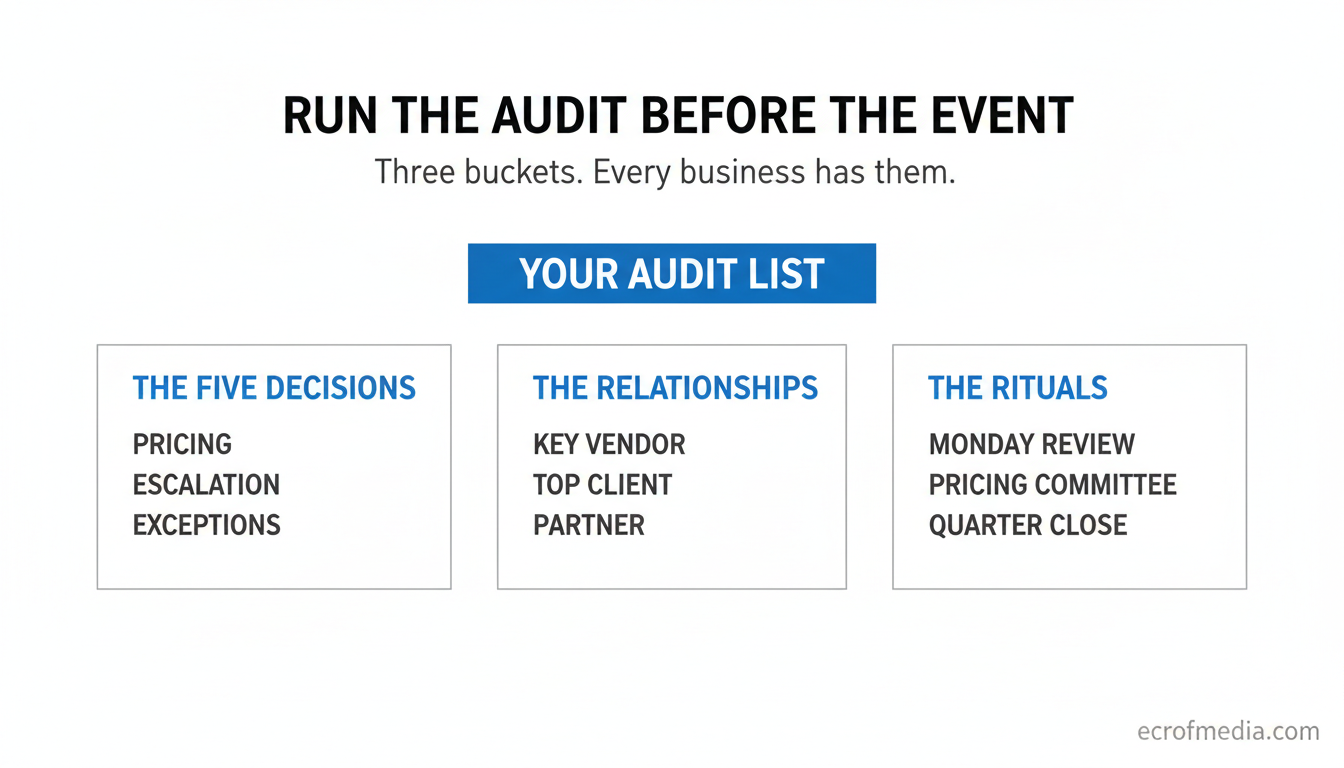
The Five Decisions
Name the five decisions in your business that only you make. Not the meetings you attend. The decisions where the business actually waits on your specific judgment because the inputs are ambiguous and the right answer depends on context you have not written down.
The Three to Seven Relationships
Name the relationships only you carry. The vendor that calls you direct. The client who will only escalate to you. The partner whose handshake is the only documentation of the deal. Identify them by name. Three to seven is the typical count in a thirty to two hundred person business.
The Rituals That Only Run Because You Run Them
Name the rituals that exist because you are scheduling them. The Monday morning review. The pricing committee. The exception escalation. The end of quarter close. The customer health check. Anything that would stop happening the week you stopped showing up.
That is your audit list.
Each item is a discount on your valuation if the event arrives before you package it.
The First Hour of a Thirteen Year Project
The work is one item at a time. Pick the most exposed item on your audit list. The decision the business cannot make without you. The relationship the business cannot transfer. The ritual the business will lose the second you are not running it.
Take that one item and package it.
Write the decision rule with its conditions and exceptions.
Introduce the relationship to two other people on your team. Put them on the next three meetings.
Hand the ritual to someone else for sixty days while you watch.
Capture what you learn into a playbook the next operator can run from.
That single move is the first hour of work in a thirteen year project. Most founder led businesses never start it. The ones who do, even if they only get through three or four items, change the shape of what happens when the event arrives.
The Brain Map is the audit run with you. Forty five minutes. We walk through the decisions, relationships, and rituals sitting inside you and name the ones that would not transfer if the event arrived tomorrow. You leave with the list and the order of operations for which one to package first.
You can book it from the resources page on the Hub.
Built to Think
The intelligence Cook spent thirteen years packaging is the same intelligence sitting inside you right now. Most of it is portable. None of it transfers until you package it. See what a Brain Map reveals about which decisions, relationships, and rituals would survive the event if it arrived tomorrow.
Where the numbers come from
- The Economic Times. Apple CEO transition coverage week of May 25 2026.
- Bloomberg. Cook successor planning and Ternus profile.
- The Wall Street Journal. Apple board governance and chairman transition.
- Harvard Business Review. Leading After the Founder. Founder CEO transition risk and performance data.
- Wipfli. 2025 State of the Banking Industry report. Succession planning data.
See this in your own business.
We run a live workshop where we walk through exactly where your business intelligence is accessible and where it is still trapped. You will leave with a clear picture of what needs to be packaged first.
Join the Live Workshop