Why Your Business Runs on Memory Instead of Systems
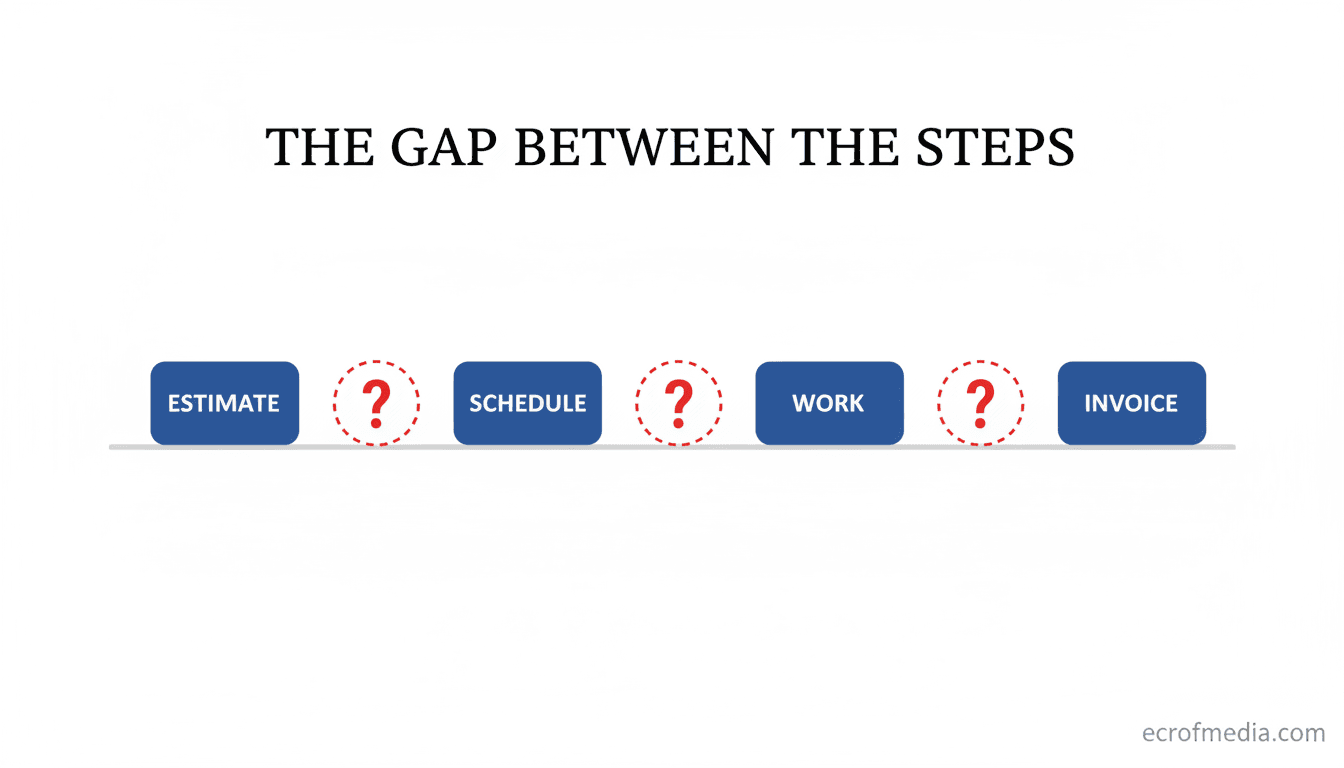
The gap between what a founder knows and what the business can access is where margin disappears, decisions stall, and growth hits a ceiling no one can explain.
You know every client's history. You remember the pricing exception you made eighteen months ago. You know which vendor charges more but delivers faster. You know the unwritten rule about which scope changes are worth absorbing and which need to be billed.
All of that knowledge lives in one place.
Your head.
And that is the most fragile infrastructure in your entire business.
This article is about the gap between what you know and what your business can actually access. That gap is where margin disappears, decisions stall, and growth hits a ceiling that no one can explain on a spreadsheet.
The Invisible Operating System
Every founder led business has an operating system. The question is whether that system is written down or stored in someone's memory.
For most businesses between $1M and $10M, the answer is memory. The founder is the operating system. They hold the logic for how things work, why certain exceptions exist, what the real priorities are, and how to handle the edge cases that come up every week.
From the outside, this looks like strong leadership. From the inside, it looks like this:
You answer the same question from different team members every month.
New hires take months to become productive because no one can transfer what you know.
Your team makes decisions that surprise you because they filled in the gaps with their own interpretation.
Client experiences vary depending on who handles them and whether you were involved.
You cannot take a real vacation because no one else carries the context.
This is not a discipline problem. Your team is not failing you. The system is failing them. Because the system is you.

How Memory Becomes a Tax
Running on memory is not just inconvenient. It is expensive. Every time the business needs information that only lives in your head, a tax gets applied. Sometimes it is time. Sometimes it is quality. Sometimes it is money. Often it is all three.
The Interruption Loop
Someone on your team hits a situation they have not seen before. They need context. They message you, call you, or walk into your office. You stop what you are doing, recall the relevant history, explain the reasoning, and give direction.
That interaction takes five minutes. But the cost is not five minutes. It is the twenty three minutes of refocus time after the context switch. It is the work you were doing that now has to be restarted. It is the three other team members who had the same question this month and went through the same loop.
The Consistency Problem
When knowledge lives in memory, it gets delivered differently every time. Your mood matters. Your energy matters. How busy you are matters. The same question asked on Monday morning and Friday afternoon gets different depth, different nuance, and sometimes different answers.
Your team notices this. They learn that outcomes depend on timing. So they start managing when and how they approach you. That is not a team operating within a system. That is a team navigating a personality.
The Onboarding Wall
Every new hire faces the same challenge. The business has processes, but the real logic is unwritten. So they shadow you. They observe. They ask questions and slowly piece together the mental model you carry. Three months in, they are still learning things you consider obvious but never documented.
That onboarding cost compounds with every hire. And it means your growth rate is directly limited by how fast people can extract knowledge from your head.

The Six Things That Should Not Live in Your Head
Not everything needs to be externalized. But there are specific categories of knowledge that, when they remain trapped in memory, create the most damage.
1. Pricing Logic
How you price. When you discount. What justifies an exception. What the floor is. If this lives in your memory, your team either asks you for every quote or guesses. Both cost you.
2. Client History and Relationship Context
Who is flexible. Who is demanding. What promises were made. What precedent was set. Your team interacts with these clients daily. Without this context, they operate blind or create inconsistencies that damage trust.
3. Scope Boundaries
What is included. What is extra. Where the line is. How much flexibility exists. When your team cannot answer these questions without you, scope creep becomes the default because saying yes is easier than waiting for your answer.
4. Quality Standards
What good looks like. What is acceptable. What crosses the line. If these standards live in your taste and your eye, every deliverable needs your review. That makes you quality control. And quality control should not cost $300 per hour.
5. Escalation Criteria
When to handle it. When to loop someone in. When to flag it. When to stop work. Without clear criteria, people either escalate everything or escalate nothing. Both create risk.
6. Decision Precedent
How was this handled last time? What was the reasoning? What was the result? Without decision memory, your team relitigates the same situations from scratch. The conversation that happened six months ago has to happen again because no one recorded the outcome.
Quick Diagnostic
Pick any one of these six categories. Ask three team members how they handle it today. If the answers are different, or if the answer is I ask you, that category is running on memory.
Why Documentation Alone Does Not Fix This
The instinct is to document everything. Write SOPs. Build a wiki. Create process documents.
And documentation has value. But documentation without architecture is just a library nobody visits.
The problem is not a lack of writing. The problem is a lack of structure that makes the writing operational.
Here is what happens with most documentation efforts:
- The founder writes detailed processes during a burst of motivation
- The documents go into a shared drive or wiki
- The team reads them once
- Situations arise that fall between the documented scenarios
- The team goes back to asking the founder
- The documents become stale because no one maintains them
- Six months later the wiki is a graveyard of good intentions
Documentation fails because it captures the what without installing the who, the when, and the boundaries. It describes process without defining authority. It records answers without creating the system that prevents the same questions from recurring.
What a System Actually Looks Like
The shift from memory to system is not about writing things down. It is about building operational intelligence that your business can access without you in the room.
That means three things:
Externalized Knowledge
The critical information that lives in your head gets extracted, structured, and placed where the team can access it in the moment of decision. Not in a document they have to search for. In the workflow itself.
Defined Authority
Every recurring decision category has a clear owner with explicit boundaries. Your team does not need to ask permission because the system already tells them what they can decide and when escalation is required.
Decision Memory
When a decision is made, the reasoning and outcome are recorded. Not as documentation for its own sake. As precedent that prevents the same conversation from happening again. The business builds institutional knowledge instead of depending on personal recall.

The goal is not to remove you from the business. It is to remove your memory as a dependency.
The Compound Effect of Getting This Right
When you shift from memory to system, the returns compound in ways that are not immediately obvious.
- Team confidence increases because people know what they are authorized to decide
- Onboarding time drops because knowledge is accessible, not oral
- Client experience becomes consistent regardless of who handles the interaction
- Your calendar opens because fewer decisions require your involvement
- Margin stabilizes because scope, pricing, and exceptions follow rules instead of mood
- The business becomes sellable because the value is in the system, not in your head
That last point is one most founders do not think about until it is too late. A business that runs on the founder's memory has an enterprise value problem. Because the buyer is not purchasing a system. They are purchasing a dependency on a person who is leaving.
Where to Start
You do not need to externalize everything at once. Start with the category that creates the most friction.
For most founder operators, that is one of two areas:
Pricing and scope decisions, because they affect margin directly.
Client escalations, because they consume the most time and energy.
Pick one. Map how it currently works. Identify every point where your memory is the system. Then design the structure that replaces it.
That single exercise will show you how much of your business is running on recall instead of architecture. And once you see it, you cannot unsee it.
Sources and References
Join Us Live
We run a live workshop designed specifically for this moment. We map where your business runs on memory and walk you through what to design first. Not theory. Structure you can install.
See this in your own business.
We run a live workshop where we walk through exactly where your business intelligence is accessible and where it is still trapped. You will leave with a clear picture of what needs to be packaged first.
Join the Live Workshop